
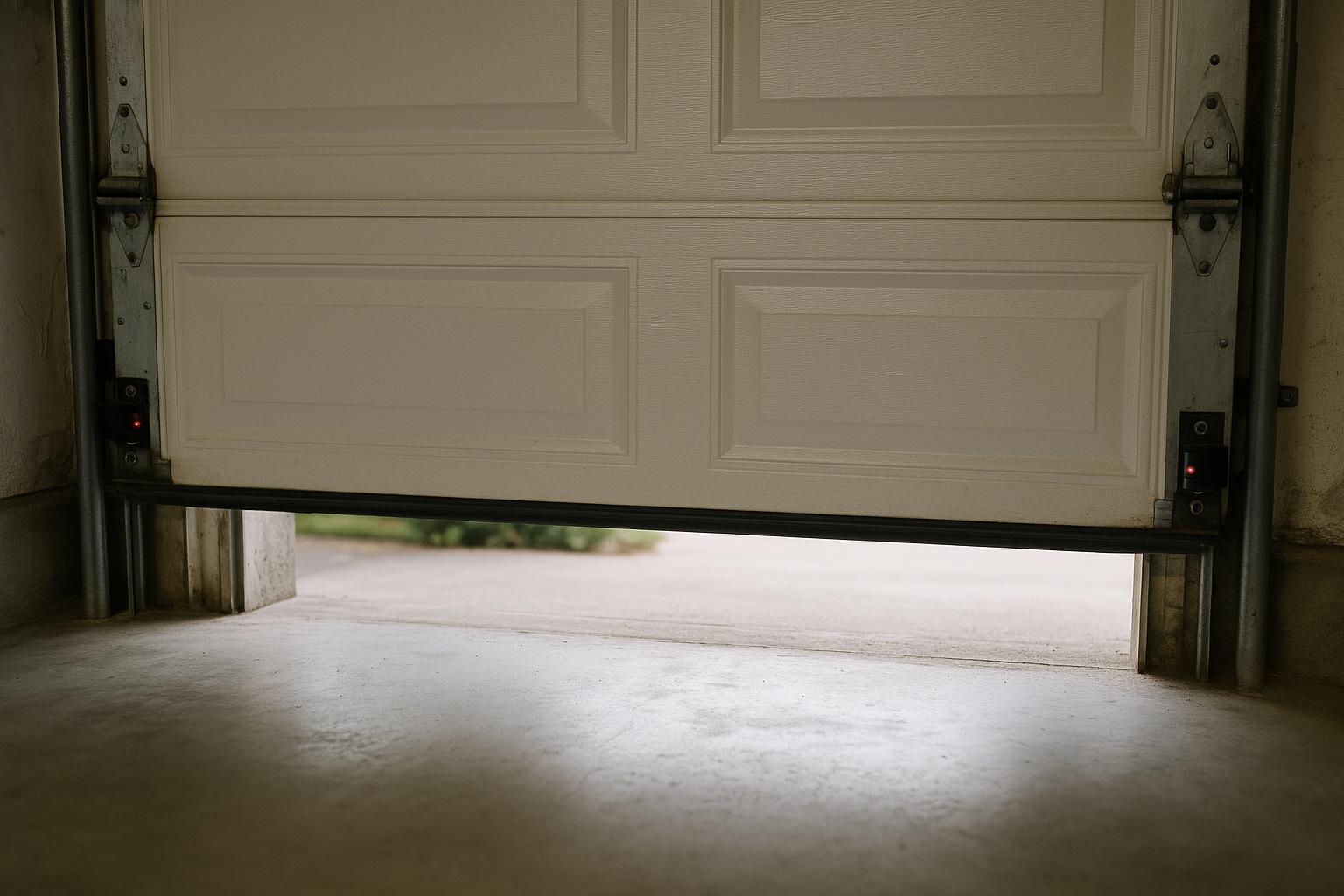
That Frustrating Moment When Your Garage Door Won't Stay Closed
You press the button on your remote, watch your garage door glide downward, and then — just inches from the floor — it stops and reverses back up. You try again. Same thing. Maybe you try holding the wall button, and it still won't cooperate.
This is one of the most common garage door problems we see here in South Euclid, and it's especially frustrating because the door seems like it's working fine until that final moment. The good news is that in most cases, the cause is straightforward and fixable. Let's walk through the most likely reasons your garage door reverses before closing all the way and what you can do about each one.
1. Misaligned or Dirty Safety Sensors
This is the number one reason garage doors reverse before reaching the floor. Every garage door opener manufactured after 1993 is required to have photo-eye safety sensors — two small devices mounted near the bottom of your door tracks on either side. They send an invisible beam across the opening, and if anything breaks that beam, the door reverses to prevent crushing a person, pet, or object.
Here's the thing: these sensors don't just react to actual obstructions. They can be triggered by:
- Dirt, cobwebs, or debris covering the sensor lens
- Misalignment — even a slight bump can knock one sensor out of position
- Direct sunlight interfering with the infrared beam
- Loose or damaged wiring between the sensors and the opener
Start by checking whether both sensor lights are lit and steady. On most models, one sensor has a green light (receiving) and one has an amber or orange light (sending). If the green light is off or blinking, the sensors aren't communicating properly.
What You Can Do
Gently wipe both sensor lenses with a soft cloth. Then check that both sensors are pointed directly at each other by loosening the wing nut on the bracket, adjusting the angle, and retightening. If the wiring looks frayed or disconnected, that's a repair best left to a professional.
2. The Close-Limit Switch Needs Adjusting
Your garage door opener has limit settings that tell it how far the door should travel when opening and closing. If the close-limit is set incorrectly, the opener may think the door has hit an obstruction when it's actually just reaching the floor — so it reverses as a safety precaution.
This problem often shows up after a new opener installation, a power outage, or when homeowners have recently made adjustments to other parts of the system. It's also common in older homes throughout neighborhoods like South Euclid and Cleveland Heights, where openers may have been installed years ago and slowly drifted out of calibration.
What You Can Do
Most openers have limit adjustment screws on the back or side of the motor unit. You'll need to turn the down-limit screw slightly (usually in small increments) to allow the door to travel a bit farther before the opener thinks it's reached its stopping point. Your owner's manual will have specific instructions for your model. If you're not comfortable making this adjustment, our team can handle it quickly during a service call.
3. Worn or Broken Cables and Tracks
If your garage door tracks are bent, dented, or misaligned, the door can bind or encounter resistance as it moves downward. The opener interprets that resistance as an obstruction and triggers the auto-reverse feature.
Similarly, if a cable is fraying or has come off the drum, the door may descend unevenly, creating enough friction to trigger a reversal. You might also hear grinding, scraping, or popping sounds as the door moves — all signs that the tracks or cables need attention.
What You Can Do
Visually inspect the tracks on both sides of the door. Look for obvious bends, gaps between the track and the wall, or debris caught in the track. Do not attempt to adjust or repair cables yourself — they're under significant tension and can cause serious injury. Cable and track repair should always be handled by an experienced technician.
4. Worn Rollers Creating Excess Friction
Garage door rollers wear out over time, especially the standard steel rollers that come with many doors. When they become worn, cracked, or seized, they create resistance that the opener's force sensor detects as a problem. The door may jerk, hesitate, or reverse partway down.
In our experience serving homeowners across South Euclid, Lyndhurst, and University Heights, worn rollers are one of the most overlooked maintenance items. Replacing them with high-quality nylon rollers not only solves the reversing issue but also makes the door significantly quieter — a big plus if you have living space above or next to the garage.
What You Can Do
You can visually inspect the rollers by looking at each one along the track. If they appear cracked, chipped, or don't spin freely, it's time for a replacement. While some homeowners replace non-tension rollers themselves, we recommend having a professional handle the ones near the bottom brackets, which are connected to the high-tension cable system.
5. The Opener's Force Setting Is Too Low
Garage door openers have a force adjustment that determines how much resistance the motor will push through before reversing. If this setting is too sensitive, the door may reverse from the normal resistance of its own weight, weatherstripping contact, or even cold temperatures making the lubricant thicker.
This is particularly relevant during Northeast Ohio winters. Homeowners in South Euclid and the surrounding areas often notice their garage doors behaving differently once temperatures drop. Cold weather increases friction in the system, and a force setting that worked fine in July might cause problems in January.
What You Can Do
The force adjustment is usually a screw or dial on the opener unit, separate from the limit switches. Increase the down-force setting in small increments and test the door each time. Be careful not to set it too high — the auto-reverse feature exists to protect people and property, and you don't want to defeat that safety mechanism.
6. Broken Torsion Springs
If a torsion spring is broken or losing tension, the opener has to work much harder to control the door's descent. In some cases, the added strain triggers the auto-reverse. You might also notice the door feels unusually heavy if you try to lift it manually, or the opener motor strains audibly when operating.
Broken springs are a serious issue that requires immediate professional repair. Never attempt to replace or adjust torsion springs yourself. These components are under extreme tension and account for some of the most dangerous DIY garage door injuries every year.
When to Call a Professional
Some of these fixes — cleaning sensors, minor limit adjustments — are reasonable for handy homeowners to try. But if you've gone through the basics and your door is still reversing, or if the problem involves springs, cables, or track damage, it's time to call in a pro.
At South Euclid Garage Door, we diagnose reversing issues every week. In most cases, we can identify and fix the problem in a single visit. We serve homeowners throughout South Euclid, Beachwood, Richmond Heights, and the surrounding communities with honest assessments and fair pricing.
A garage door that won't close isn't just an inconvenience — it's a security risk for your home and everything inside your garage. If your door is giving you trouble, don't ignore it. Give us a call and we'll get it sorted out so you can get back to pressing that button with confidence.